Click any image to see it enlarged.
Stardust Odyssey: City's Last Stand is built for 4 players (feel free to scale the player count up or down for your own group). A session runs about 1–2 hours.
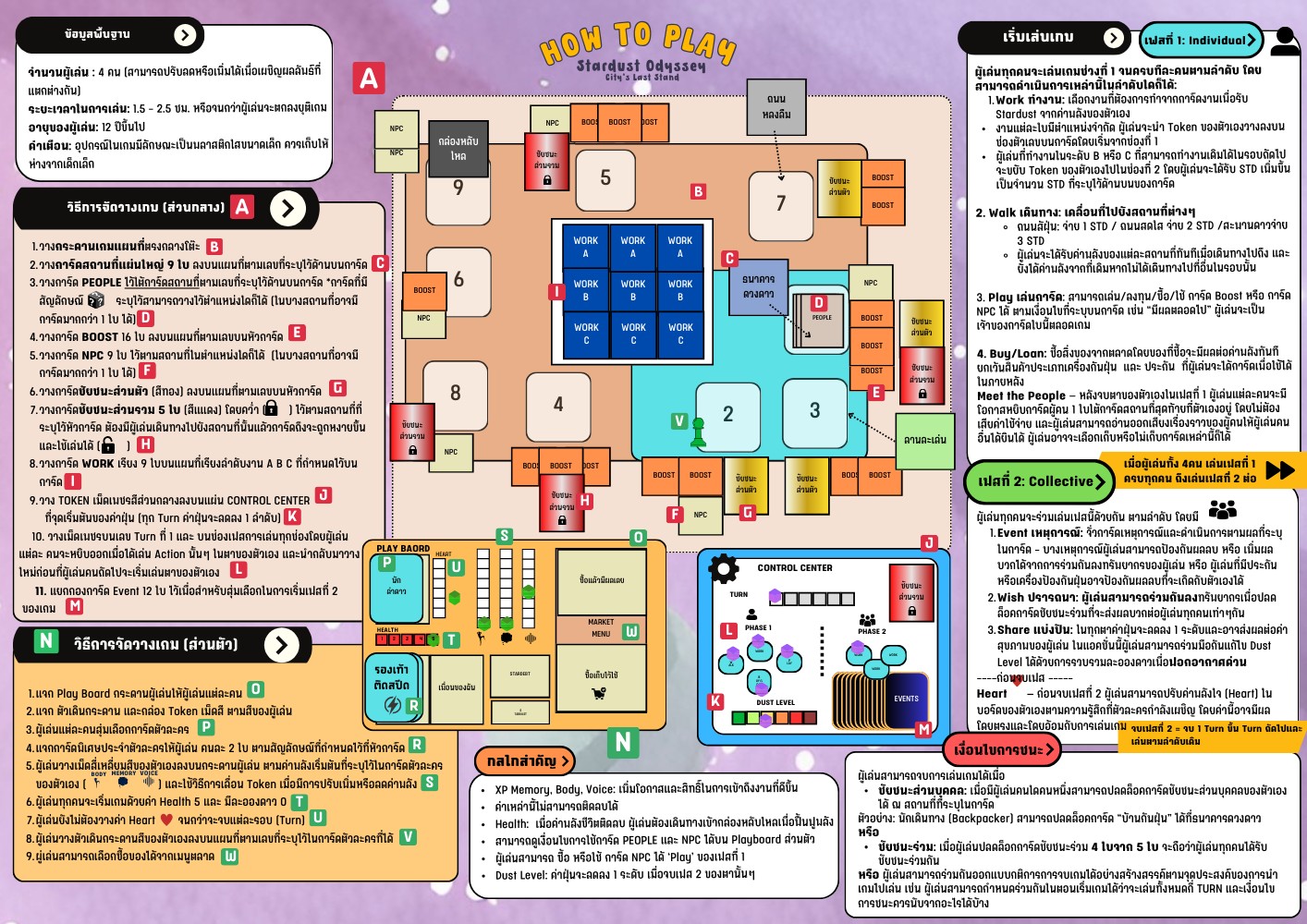
Main Board
1. Lay out the main board and place the Location cards according to the numbers marked on the map.
2. Place the People cards face-down under the Location cards. People cards marked with a question mark (?) can go under any location.
3. Place the Boost cards according to the numbers on each card.
4. Place the Individual Victory cards according to the numbers on each card.
5. Place the Collective Victory cards according to the numbers on each card as well, but face-down — these are locked until a player physically travels to the location where the card sits, which unlocks it for play.
6. Place the NPC cards at any location on the map.
7. Place the Work cards sorted by rank.
8. Place the central tracker token to mark which phase the game is currently in. At the start of the game, set the dust-level token to its starting position (level 3).
9. For Turn 1, place a token on every Phase 1 action space — players remove these tokens as they take that action on their turn — then do the same for every Phase 2 action space.
10. Set out the Event card deck and the Public Transport Campaign cards.
Each Player's Board
Every player gets their own play board with two key tracks: Stardust (the currency you earn throughout the game) and Stardebt (any debt you take on, which accrues at double interest).
1. Randomly deal each player one of the 4 characters and place that character card on your play board.
2. Each character is born in a different location — place your character token at your birthplace.
3. Place your Special Item card on your play board.
4. Set your starting stats (each character begins with different stats) before play begins.
5. If a player's Health drops to 0, that player must spend 1 turn in the Sleeping Box.
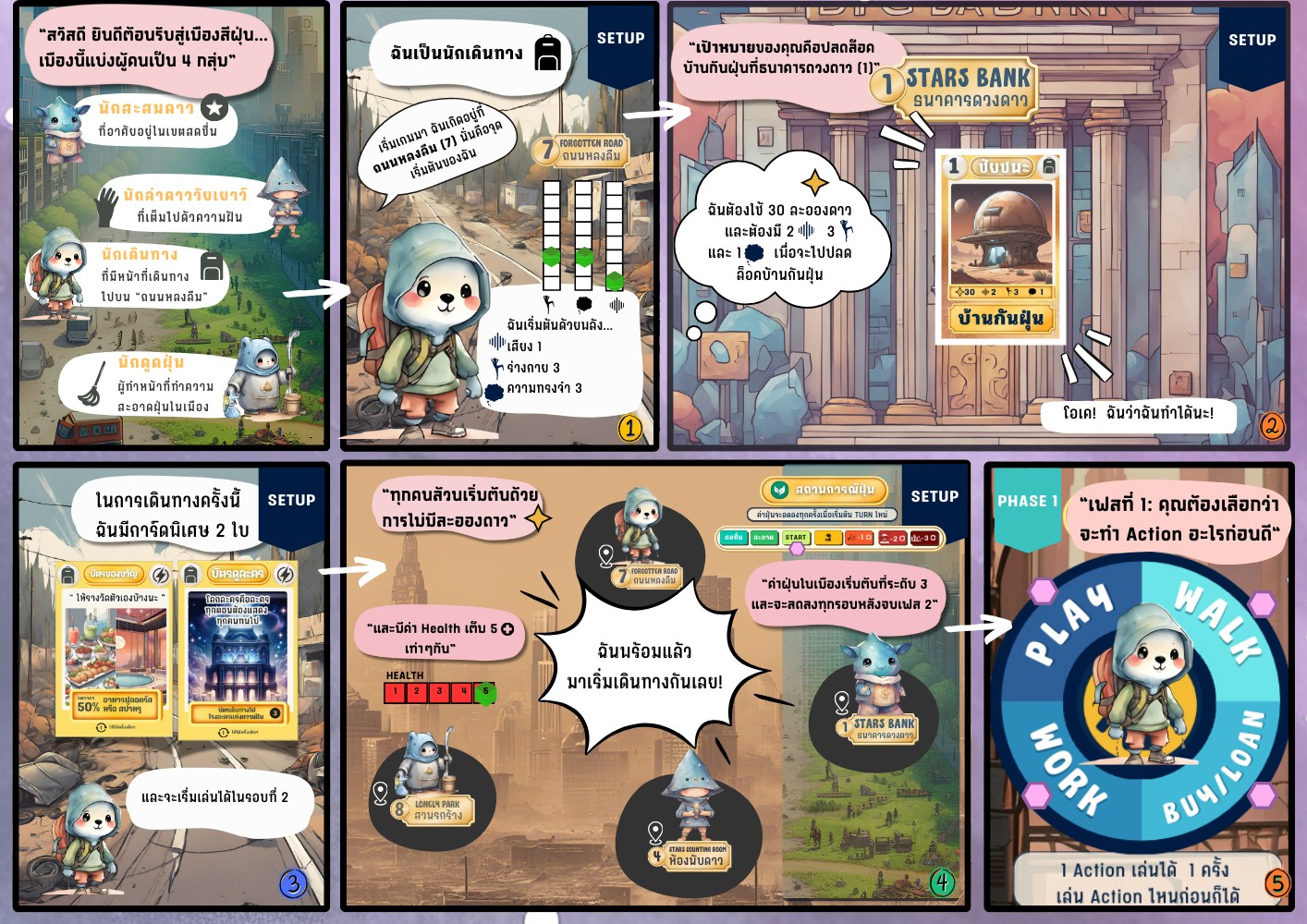
Example: At the start of the game, my character is born on Forgotten Street, my starting location. I begin with Voice 1, Body 3, and Memory 3. My personal goal is to unlock a dust-proof house from the Star Bank, which requires 30 Stardust plus Voice 2, Body 3, and Memory 1. I hold 2 special cards that I can use starting from round 2. Every player begins with 0 Stardust and full Health (5/5). The city's dust level starts at 3 and drops every round after Phase 2 ends.
Before you dive in, it helps to understand each of the core stats that shape how your character moves through the game:
Voice — your ability to speak up, negotiate, and influence others in society.
Body — your physical strength, used for heavy labour and long journeys.
Memory — how well you're remembered or recognised by society.
Health — your life force. If it drops to 0, you must spend 1 turn in the Sleeping Box.
Stardust — the game's currency. Earned through work, travel, and other actions; spent on goods, unlocking cards, or repaying debt.
Stardebt — debt taken out as a loan, at double interest (borrow 2, repay 4). If you complete your personal goal without clearing your debt, it doesn't count as a win.
City Dust Level — a shared, citywide stat. It starts at level 3 and drops every round after Phase 2, affecting everyone's Health — unless the group works together to clean the air during Phase 2.
Morale Token — before Phase 2 ends, each player assesses their own state of mind and places a token accordingly, reflecting how they're feeling as the game unfolds.
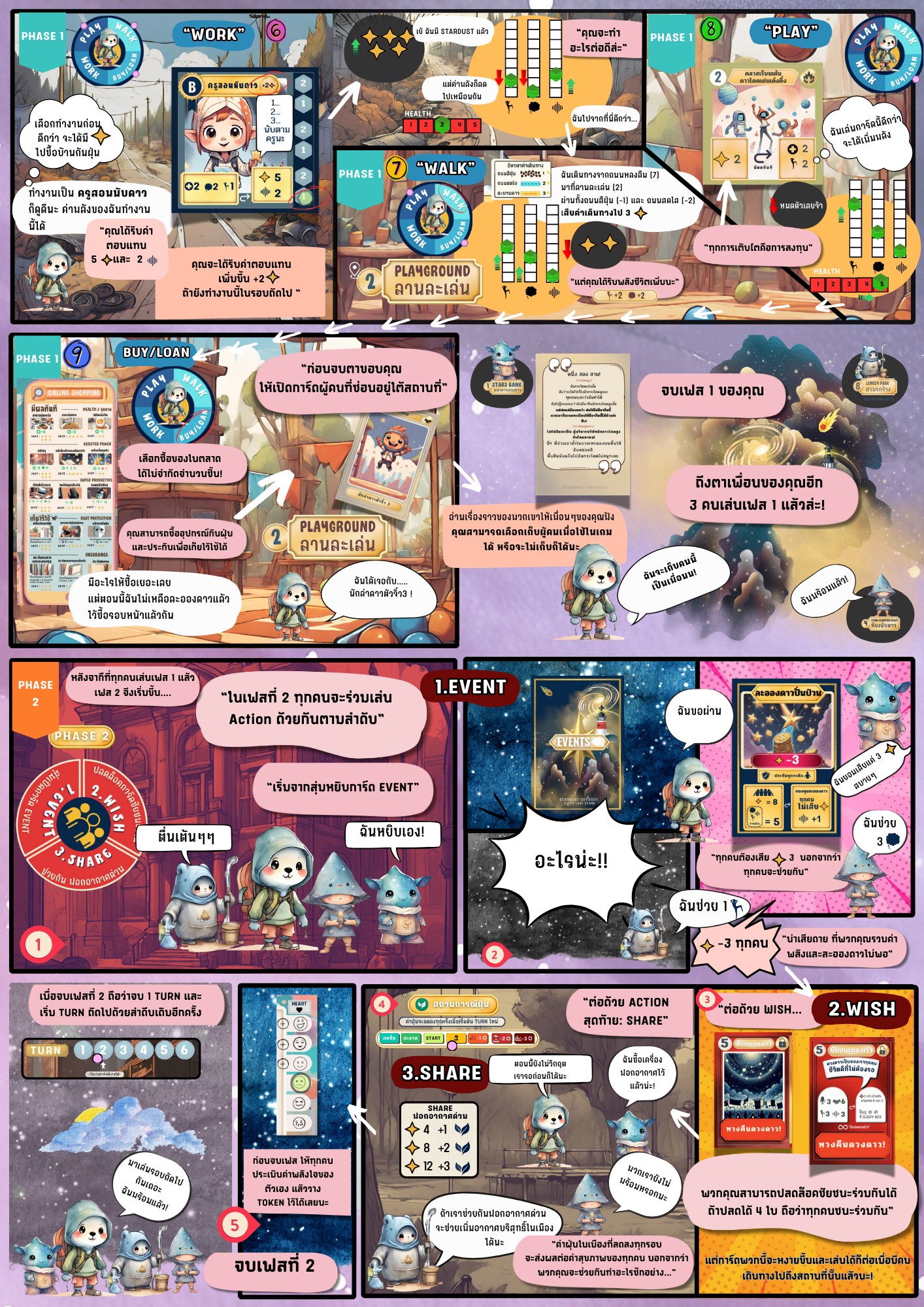
Each turn has two phases: Phase 1 (individual actions) and Phase 2 (collective actions). In Phase 1, on your turn, choose one action (in any order across turns):
Play — buy, keep, or use a card. For example, play a dance class card: pay 2 Stardust to gain Health +2 and Body +2.
Walk — travel from one location to another. Travelling costs Stardust, but you gain stat increases every time you move, because every step of growth is an investment.
Loan — shop the market with no limit on how many items you buy (dust-protection gear, insurance, and more to stock up for later), or borrow Stardust at double interest (borrow 2, repay 4). There's no rush to repay — but if you complete your personal goal without clearing your debt, it doesn't count as a win.
Work — take a job at any rank you qualify for to earn Stardust and other stats. Sticking with the same job into the next round can pay out more, though some of your stats may dip in the process.
Before ending your turn, reveal the People card hidden under your current location and read their story aloud to the group. You can choose to keep that card to use later in the game, or let it go.
Reading the symbols on People/NPC cards: handshake (×4) / microphone (×2) / shield (×3) symbols protect you from being sent to the Sleeping Box. A shield (×1) symbol sends another player to the Sleeping Box for 1 turn (they skip their next turn unless they pay 5 Stardust to get out early). A microphone symbol lets you give the card to any player in exchange for 2 Memory.
Once the first player finishes Phase 1, the remaining three players take their own Phase 1 turns in order. Phase 2 begins only after everyone has completed Phase 1.
In this phase, all players act together, in this order:
1. Event — reveal an Event card at random. Everyone has to deal with its consequences together. For example, a "Stardust Turmoil" event might cost everyone 3 Stardust unless the group helps each other cover it (negotiate who contributes what).
2. Wish (unlock Collective Victory) — if a player has travelled to a location holding a Collective Victory card, and the group's combined stats/Stardust meet the requirement, that card unlocks. Unlock all 4 Collective Victory cards and everyone wins together.
3. Share — the city's dust level drops every round, which affects everyone's Health unless the group works together to clean the air. Pool your Stardust: pay 4 together for +1 clean air, pay 8 for +2, or pay 12 for +3.
Before ending Phase 2, every player assesses their own morale and places their token accordingly. That completes one full turn — start the next turn in the same order.
Keep playing until someone achieves their personal goal (Individual Victory) or the group unlocks all four Collective Victory cards together (Collective Victory). Either way, that's a win.