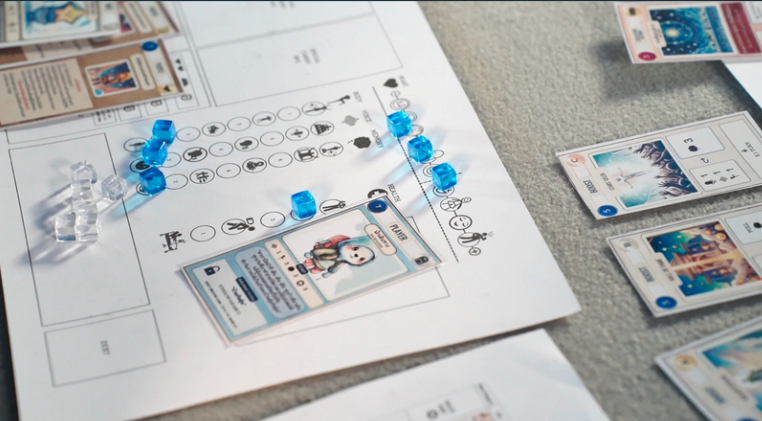
Stardust's Odyssey is a game set against the backdrop of an unequal society. ...In a world where people are treated unequally, the most valuable asset isn't the amount of money in your pocket but the question of "who you are."
Parichat Chaiwong — Workshop Facilitator & Player
The first time I participated as a player in Stardust's Odyssey, I took on the role of Star Collector whose personal goal was to create a theatre production to record my own history. I found myself unable to pull away from the mindset of being a star collector, focused on accumulating resources with all the advantages I had.
Holding enough resources to dictate the direction and course of society as I wished led me to exercise power over the other participants to an unprecedented extent, despite knowing it wasn't beneficial to the group.
That opportunity came during the final playtest, where I was again cast as the star collector. I set my sights on playing as a ruthless elite, focused on maintaining my status while trying to hinder the other players from uniting.
In this last round, the power of the star collector was constantly challenged, threatened, and undermined by the other players, especially the vacuum cleaner, who rallied the star hunter and traveller, convincing them that they should join forces and, if necessary, steal resources from the star collector to help society overcome its crises.
The final round of the playtest highlighted the game's ability to explore power dynamics between the oppressed and the oppressor, showcasing collective consciousness and class struggle clearly.
Beyond the emotions and experiences during gameplay, Stardust's Odyssey is a game set against the backdrop of an unequal society. In a world where people are treated unequally, the most valuable asset isn't the amount of money in your pocket but the question of "who you are."
Throughout the playtests, both as a participant and as a facilitator, I observed only one player demonstrate real transformation: the labour rights activist who played the vacuum cleaner. Their assigned goal was to collect 10 stardust, which seemed relatively easy. However, this player rewrote their character's dream, turning it into a revolution.
As a teacher, this game has inspired me to apply it in various educational dimensions. What stands out most is the character cards, which open up space for the identities and voices of people who are often not recognised as important by the state or central authority.
Stardust's Odyssey is not just a board game that makes class struggle and inequality tangible. It's a game that captures the stories and identities of people who have contributed to shaping Thailand's economic and political memory, all while being engaging and challenging.