This game may not be about being ‘good’ or ‘bad’ at playing — it pushes us to question what makes ‘being good’ possible in the first place.
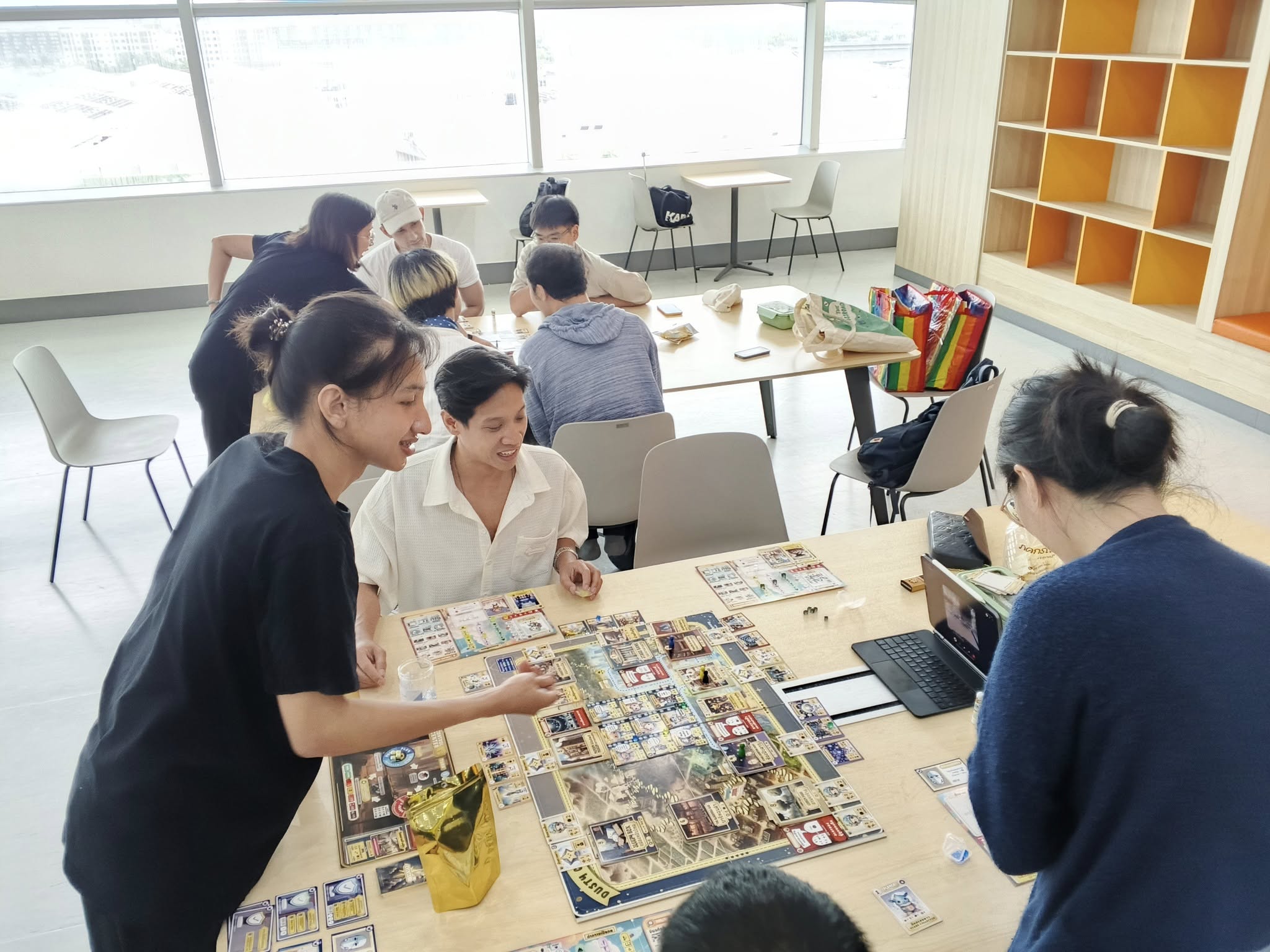
What made this session special was that we ran two tables at once. We keep the focus on letting the game carry players where it will — no hidden ‘god,’ no facilitator playing a character, just a game master acting like a chatty rulebook, standing at the table the way a dealer stands at a casino. Today another facilitator helped run the second table, and a teammate helped keep everything running smoothly. It made the whole thing effortless.
The game pulls players into talking, arguing, and negotiating the way real life does. But as the designer who wants this game to function as a performance, I got to be an audience member too, picking up striking lines from yesterday's two tables.
The first table, led by the other facilitator, played almost like the First World — lucky enough that the Event cards weren't too harsh while they were building themselves up. Players gradually unlocked Collective Victory cards that raised everyone's quality of life together, so that by turn six, inequality was still visible on each character's board, but no one had been left behind. Standing beside them, all I heard was: ‘We need to help find this. We need to help do this. Let's find this person.’ Unlocking basic rights let them ‘share the ease’ across each character's very different path through life.
Cut to the other table we were running. Bad luck struck from turn one — they'd barely been born into the game before drawing one of the harshest Event cards in the deck. The mostly-introverted table suddenly got loud. One player started negotiating, body language shifting, voice raw and unrehearsed. Everyone had to negotiate, because this crisis meant every life at the table, not just the ones with the fewest resources. On that single Event card alone, they spent over half an hour negotiating. Looking over at the other table, which had started later and was already ahead, this group's crisis meant they were starting to ‘share the hardship’ — there was no shared ease yet.
From turn one, they agreed to split the debt between them. In that first turn, before anyone had earned much Stardust from work, everyone looked equally stuck. But one player — playing the character with the lowest starting ‘humanity’ stats: voice, body, and memory — pointed at a teammate's board, full of exactly those values. ‘They don't have money, but they have more chances to go earn it than we do.’ A line that jolted both players and onlookers into seeing the game's message surface.
Even though the mood at this unlucky table looked heavy and darkly funny, red Stardebt tokens sat on every player's board for 80% of the session. But it was precisely this hardship that let us see this table build a shared social consciousness from the very start of the game. The pain, the harshness, didn't split them apart — it made them hold each other up. Not through polite, principled debate, but through an argument rooted in the plain human need to survive together.
They kept snapping at each other while helping each other out (laughs). ‘My own goal means nothing if we all die,’ one player said mid-game, once the session had passed the halfway mark. The first Collective Victory card they managed to unlock was ‘A Play for the Disappeared,’ which permanently restored everyone's Memory stat to full. Once memory was returned to the smallest people at the table, work became easier to take on — cards designed to strip away memory lost their bite, and even the wealthy character's special card, which let them ‘live as poor’ to steal memory from other players, became meaningless.
By turn five, the table had unlocked some, though not all, of the red cards, and had started to breathe again and pay down debt — goods got cheaper, transport got cheaper, and clean air became something everyone had access to. Then came a moment of pure comic relief: players from the ‘First World’ table, who had unlocked nearly every Collective Victory card and already finished, wandered over to this table's world.
Two bright-eyed players walked over and asked what those ‘red tokens’ even were — they'd never seen Stardebt in their own city. Their genuinely curious questions made them look like kids from a wealthier planet on a field trip to the dusty city (laughs), while the people actually living in that city sat there, heads in hands, racing to clear their debt before the session ended. This board game keeps showing us it's about more than content and mechanics — because it's performed live, in different spaces with different people, it keeps generating new messages and new stories every time.
If we'd only run one table, we'd have seen only one perspective, one society's conversation. But running two tables side by side today made the bigger picture of a global society much clearer. Are children born into war, severe economic crisis, disaster, or the aftermath of colonization somehow less entitled to their humanity than children born where everyone eats well and sleeps soundly? Is a board full of debt because those players simply weren't skilled enough — or because the ‘story’ of their country was written to leave their pockets empty from the very start? This game may not be about being ‘good’ or ‘bad’ at playing — it pushes us to question what makes ‘being good’ possible in the first place. It might not start with effort at all, but with more resources, social safety, economic security, physical and mental health, and the basic humanity someone was granted — effort might just be the last ingredient that completes that ‘skill.’
It's been a full year now since this game began slowly developing and meeting people, one small batch of sets at a time. We've been rolling it forward like a snowball, hoping it reaches people who might carry it further. Thank you so much to everyone who's joined us on this journey through the dusty city. Counting both official and unofficial sessions, over 50 people have now spent time playing this game, and we hope it keeps getting passed on. The game may not have one fixed ending, but we have a clear intention: to keep building conversation and critique around inequality, while carving out a path — and a dialogue — toward a new imagination where our planet tilts just a little less.